

Last updated 2nd Nov 2026
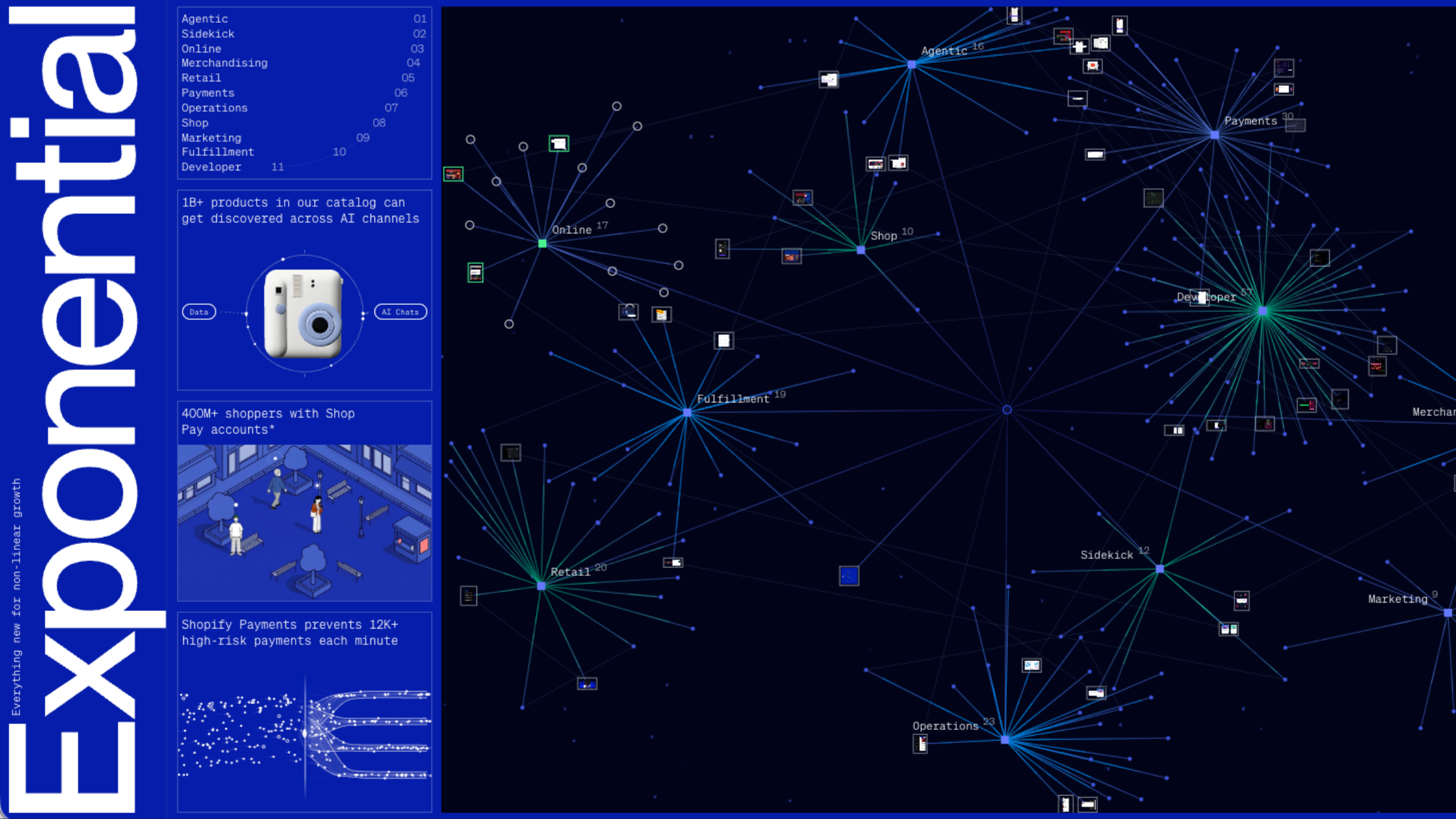
Shopify released its Fall '26 Edition, titled "Exponential", on 28th Oct. There are more than 150 updates, and the timing is unusual. Last year's equivalent arrived on 10th Dec; this one landed a month before Black Friday. A lot of it is early access or "coming soon", and we would recommend keeping all of it away from your live store until peak is over.
Most of the updates point the same way. Shopify wants stores to be readable and buyable by AI, whether that's a shopper's agent finding your products or Shopify's own AI editing your store.
We've split what matters into three parts. First, the handful of short-term actions worth doing before Black Friday. Then the changes to plan for in Q1 2027, including one hard deadline. Finally, the longer-term shifts that will shape how your store is found, bought from and built over the next few years. We've skipped the POS, B2B and app developer updates, which matter less for most DTC brands.
At a glance
| Action | When | Who owns it |
|---|---|---|
| Mark the 21st Sep analytics change on conversion reports | Now | Ecommerce / analytics |
| Review your AI knowledge base and Catalog eligibility | Before Black Friday | Ecommerce |
| Check compare-at prices are genuine | Before Black Friday | Ecommerce / trading |
| Hold storefront and checkout changes | Until January | Everyone |
| Audit apps for script tags | Before 1st Mar 2027 | Dev team or agency |
| Test Shop Campaigns against current paid channels | Q1 2027 | Growth / paid media |
Before Black Friday
Reset your conversion rate baseline (live). This one is already live and is skewing some reports. Since 21st Sep, Shopify has counted sessions differently, so sessions, conversion rate and other session-based metrics may look different without any change in traffic or behaviour. Bot traffic is now filtered more consistently, and orders, sales and customer counts are untouched. If your conversion rate jumped in late September, that's probably the measurement, not your site. We'd suggest marking the date on any chart going to a board, especially for BFCM year-on-year comparisons. Shopify's changelog note explains what changed.
Check what AI agents are being told about you (available). A new knowledge base lets you review and approve the facts shared with agents, including policies and FAQs, and a separate check shows whether your store is eligible for Shopify Catalog and what to change to qualify. It takes half an hour and decides how ChatGPT describes your returns policy, so we would recommend doing it before Black Friday.
Tidy your compare-at prices (available). Agents now receive your compare-at price via Shopify Catalog, so markdowns show up with no extra setup. UK consumer law already expects reference prices to be genuine. An AI repeating a dubious one to shoppers makes it more visible, not less.
Leave the storefront alone. Some checkout changes are on Shopify's side and rolling out soon, including tiled payment options and a tighter form layout. It's worth watching checkout conversion in case they land mid-peak, and we'd recommend holding your own changes until January.
Q1 2027: plan now, act after peak
Audit your apps before March (hard deadline). Apps have been unable to create or update script tags since 1st Oct 2026, and script tags stop running on storefronts on 1st Mar 2027. Any app still relying on them will stop working on your storefront, and Shopify's deprecation guide sets out the replacements. We would recommend using the deadline to cut the app stack back properly. Fewer apps means a faster site, fewer things breaking at 9pm on a Friday and a smaller security risk, which we covered after last month's checkout hijack.
Rollouts is now properly useful for launches (available). You can schedule a launch, event or experiment that bundles theme, checkout, catalogs and discounts into one rollout, and roll back automatically when a promotion ends. For launch days, that's a big improvement. For an ongoing testing programme, Shoplift and similar tools still do more.
Sidekick can take on the admin (early access for some features). It can now plan a set of changes, get one approval and apply them together, such as rewriting descriptions across a whole collection. It also suggests improvements tested with SimGym, Shopify's simulated shoppers. We'd treat those as ideas to test on real customers. A simulated shopper hasn't spent any money.
Better tools against fraud and chargebacks (rolling out). Shopify Protect will block fraud before orders are placed, use AI to help win disputes and let you write your own fraud rules, with features arriving soon. Worth reviewing if chargebacks are denting your margin.
More native marketing tools (available). Shop Campaigns now covers more than 35 new markets including the UK, and you only pay when an ad results in a sale. We would recommend running a controlled test before committing budget. WhatsApp marketing and Campaign Autopilot have also expanded, but if Klaviyo already runs your retention, splitting it across two platforms causes more problems than it solves. Native is a floor, not a ceiling.
Smaller wins. Custom checkout fields for delivery instructions and gift messages are rolling out, which is good news for food and drink brands with a big gifting season. UK brands can also buy DHL Express labels in the admin and ship to Royal Mail pickup locations, so customers don't miss deliveries.
The longer view
AI shopping is here, but the UK is behind. Shopify now sells into Google Search, including AI Mode, and the Gemini app, with checkout handled by Shopify. For UK brands there's a catch: direct checkout requires a US-based store selling to US customers, while shoppers elsewhere can still find your products and are sent to your site to buy. For most of our clients, this is a discovery channel for now, and your product data does the selling. Our guide to agentic commerce on Shopify covers what good product data looks like. Reporting will have gaps too. Google Analytics and custom pixels don't fire on direct checkouts in Google AI Mode, Gemini or Meta, so we'd suggest treating Shopify's sales channel reports as the numbers to trust.
Shop is becoming a marketplace. Shoppers can now add products from several brands to one cart and pay in one tap, and your store's branding and merchandising can sync to your Shop landing page automatically (early access). That's more reach, with Shopify holding more of the customer relationship. Our view: take the sales, and keep investing in what you own, meaning customer accounts, subscriptions and your email list. It also helps that you can now link Shop sign-in to Klaviyo forms, so verified customers are identified earlier.
How Shopify stores get built is changing (early access and developer preview). Canvas lets you design the whole store in one view with Sidekick, but it's early. At launch it didn't support third-party themes, app blocks, markets, translations, rollouts or theme updates, and only works on desktop. App blocks are the pieces apps add to your pages, such as a Recharge or Skio subscription widget on a product page or a reviews widget under it. For a subscription brand, those sit on the pages that make the most money, so we wouldn't recommend Canvas for an established store yet. The more important change is a new theme architecture that builds pages in Liquid with blocks and typed contracts, uses markdown files to guide AI agents, and has Tailwind styling built in. It's in developer preview, so we wouldn't recommend rebuilding yet, but this is the format future Shopify builds will use.
That's the context for Shopify buying Tailwind Labs, announced on 9th Sep, with Tailwind CSS remaining open source under the MIT licence. New sign-ups to the paid products, Tailwind Plus and ui.sh, have closed, though existing customers keep access. For our clients, nothing changes. We already use Tailwind across all our builds, so your store is written in the same styling language Shopify has chosen for its own architecture. When the new format leaves preview, that puts you closer to it than most.
Where we'd start
If you only do one thing before Black Friday, check your knowledge base and Catalog eligibility. It takes half an hour, and it shapes how AI assistants describe your brand during the busiest weeks of the year. After peak, the script tag deadline is the one most likely to catch brands out, because nobody tends to own it. We would recommend booking the app audit in for January rather than leaving it until February.
Most of the rest of this Edition is in early access, and none of it needs switching on straight away. The brands that get the most from it will be the ones that pick what fits their store and leave the rest. If you'd like our view on which updates are worth it for yours, get in touch with the team, or speak to your account manager if you already work with us.
FAQs
When do Shopify script tags stop working?
On 1st Mar 2027, script tags stop running on Shopify storefronts. Apps have been unable to create or update them since 1st Oct 2026, so any app still using them needs replacing before March.
Can UK Shopify stores sell through Google AI Mode and Gemini?
UK products can be found in Google AI Mode and Gemini, but shoppers are sent to your own store to buy. Direct checkout inside Google is currently limited to US-based stores selling to US customers.
Why did my Shopify conversion rate change in September 2026?
Shopify changed how it counts sessions on 21st Sep 2026, filtering bot traffic more consistently. Sessions and conversion rate may look different as a result, but orders and sales are unaffected. Treat 21st Sep as a new baseline.
Want to read more? Check out our post on the latest changes to subscription renewal legislation.